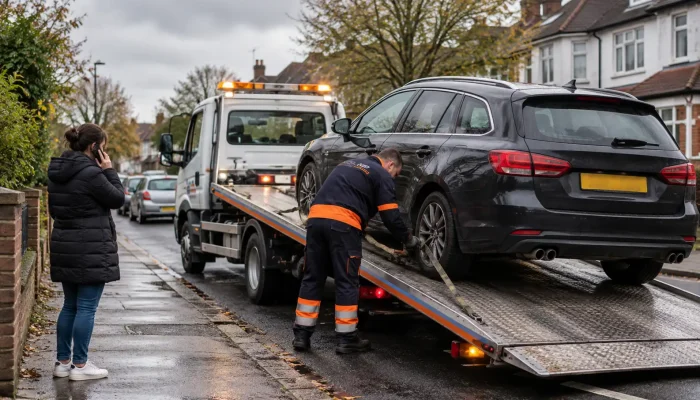
Your car has stopped, and you’ve just realised you have no breakdown cover. Take a breath. You are not stranded. You can still get safe, get help and get home, and this guide walks you through it in order. Broken down with no cover at all? You can still get emergency breakdown help today. Here is who to call, what it costs and how to avoid being overcharged.
Get yourself and your passengers to a safe place first, and call 999 if you are in danger. Then you have three realistic options: call a local recovery company that works on a pay-as-you-go basis, phone a national breakdown provider and ask for emergency cover, or ring a local garage. Whichever you choose, ask for the total price before anyone is sent out.
Key takeaways
- Safety comes before everything else. Hazard lights on, get out of the vehicle safely and stay away from traffic.
- On a motorway, never place a warning triangle on the carriageway. Leave by the left-hand door and wait behind the barrier.
- You can still get recovery without cover, but you will pay for it on the day.
- Don’t try to buy breakdown cover online once you’ve already broken down. Most policies have a waiting period, so phone a provider and ask about emergency options instead.
- Give your exact location and ask for the full price in advance.
First, get safe: what to do in the first five minutes
Everything else can wait. Your safety, and that of your passengers, is the priority.
If you break down on a normal road
The Highway Code (rules 275 to 287) sets out the basics:
- Put your hazard warning lights on if the vehicle is causing an obstruction.
- Move the vehicle off the road if you can do so safely.
- Wear light-coloured or reflective clothing if you have any, especially at night or in poor visibility.
- Use a warning triangle if you have one and it is safe to do so. Place it at least 45 metres behind the vehicle on the same side of the road. Take great care putting it down.
- Keep your sidelights on if it is dark or visibility is poor.
- Don’t stand between your vehicle and oncoming traffic. Get yourself and your passengers somewhere safe, such as behind a barrier or up on the verge.
If you break down on a motorway
Motorways are the most dangerous place to break down, so the rules are stricter:
- Try to leave at the next exit or pull into a service area. That is the safest place to stop.
- If you can’t, pull into an emergency area or onto the hard shoulder if there is one.
- Switch your hazard lights on.
- Get out by the left-hand door and have your passengers do the same, then wait behind the barrier, well away from traffic.
- Never put a warning triangle on the motorway.
- Use the emergency telephone if you have no phone signal. It connects you to the control room and shows them your location.
- Keep animals in the vehicle or, in an emergency, under control on the verge.
When to call 999
Call 999 if you or anyone else is in danger, if the vehicle is stuck in a live lane, if someone is injured, or if you feel unsafe where you are. Don’t wait to find a recovery company first.
Who can you call if you don’t have breakdown cover?
Once you are safe, you have several options. None of them is perfect, so here is how they compare.
| Option | Best for | Watch out for |
| Local recovery company (pay as you go) | Quick local help, with a price agreed up front | Prices vary, so always ask for the total first |
| National breakdown provider’s emergency cover (by phone) | A recognised name and a roadside patrol | Usually a fee on the day, and it costs more than joining in advance |
| Local garage | Short, non-urgent local tows | Limited opening hours and equipment |
| National Highways (motorways only) | Safe traffic management and guidance | Recovery is not usually free |
Pay-as-you-go local recovery
Many independent recovery companies work without any membership. You call, give your location and details, agree the price and they come out. This is often the quickest route in London because a local operator is close by. For a rough idea of what to expect, see our guide to how much car recovery costs in the UK.
Emergency cover from a national provider
National breakdown providers such as the AA, the RAC and Green Flag generally offer a phone service for people who aren’t members. Expect to pay an attendance fee on the day.
One warning: don’t buy cover online after you’ve broken down. Most policies don’t start straight away, and a provider may not help if you buy cover while already stranded. Phone and ask what they can do for you right now.
A local garage
Some garages offer a tow service, but many aren’t open around the clock and may not have the right vehicle for your car. This works best in daytime when you are close to home.
Check whether you already have cover
Before you pay for anything, spend two minutes checking. Some car insurance policies include roadside assistance, and some leased or new cars come with manufacturer breakdown assistance. A packaged bank account may also include it. If you find some, call that provider first.
Roadside assistance without cover: your options
You don’t need a membership to get roadside assistance. Local recovery firms and some national providers will help non-members for a fee on the day. For a flat battery, ask for a jump start first, because it usually costs much less than a tow. For anything else, ask for the full price before the truck is sent.
If you’re safe and would rather speak to a local company, call HP Recovery LTD on +44 7440 373860.
What if you break down on the M4, M25 or near Heathrow?
West London drivers often end up on busy, fast roads. A few things are worth knowing.
Smart motorways and emergency areas
Parts of the M4, including the stretch between Hayes (junction 3) and junction 12, are smart motorways with the hard shoulder converted into a running lane. On these sections there are emergency areas at regular intervals, each with a telephone linked directly to a control room. If you can reach one, use it. If you can’t, hazards on, leave by the left and get behind the barrier if it is safe.
Who recovers you on a motorway?
If you are in danger, call 999. Otherwise, National Highways can be reached on 0300 123 5000 for guidance. In some cases, National Highways or the police may direct your vehicle to be removed from the carriageway, and you may be charged for that. Free recovery applies only in specific situations when it is activated on certain smart motorway sections, so don’t assume it will be free.
How to explain exactly where you are
A vague location slows everything down. Give the road name or number, direction of travel, the nearest junction and any marker post number. A phone location-sharing link can help, too.
What to say when you call a recovery company
A good call saves time and avoids surprises. Have this ready:
- Your exact location and, if you can, the destination you want the car taken to
- The vehicle: make, model, and whether it is a car, van or light commercial vehicle
- What happened: won’t start, warning light, overheating, flat tyre, accident
- Condition: does it roll and steer, and do you have the keys?
- The total price, including VAT and any out-of-hours or motorway charge, before the truck is sent
Ask how long they expect to take, and whether they will use a flatbed. Electric cars, many automatics and some four-wheel-drive vehicles are better carried than towed. If you’d like a clear price for your exact situation, request a recovery quote.
Can you fix it yourself or wait?
Sometimes the problem is simple, but only try if you are somewhere safe.
Quick, safe checks
- Won’t start and the lights are dim or dead: this is often a flat battery.
- Dashboard warning lights: note which ones, because they help the recovery company.
- Fuel: check the gauge before assuming something worse.
When a jump start is enough
A flat battery doesn’t always need a tow. A jump start service can get you moving again, usually far more cheaply than a recovery. If the car stalls again soon after, the battery or charging system probably needs checking at a garage.
When to stop trying
Don’t attempt repairs on a live road, and don’t stand in traffic to check under the bonnet. If in doubt, call for help and stay somewhere safe.
How much will it cost without cover?
It depends on distance, location, time of day and vehicle type. Typically you will pay a call-out fee plus a per-mile charge, with extra for nights, weekends and motorways. Some operators may also charge storage if the vehicle is held. Our full UK car recovery price guide explains how quotes are built and what to ask.
Spot the red flags when you’re stranded
Being stranded makes it easy to agree to anything. Watch for:
- No price given until the truck arrives
- A price that changes on scene without a clear reason
- Pressure to decide immediately when you are not in danger
- Unmarked vehicles or a company with no name
- Cash-only demands with no receipt
A reputable recovery company will tell you the price, who is coming and roughly when.
After the recovery: what next?
Once the car is at a garage or home, you have a few decisions to make.
- Get a proper diagnosis before agreeing to repairs, and ask for a written estimate.
- Arrange onward travel if the car will be off the road for a while.
- Decide whether it is worth repairing. If the repair costs more than the car is worth, a scrap car collection might be worth considering.
Is it worth buying breakdown cover afterwards?
It depends on how often you drive and how old the car is. Cover usually works out cheaper if you drive often or own an older vehicle. If you rarely need help, paying per recovery may cost less over time. If you do take out cover, remember most policies have a waiting period, so it won’t help in the next 24 hours.
Breakdown help in Hounslow, Southall, Hayes and Hanwell
Breaking down in West London usually means dealing with heavy traffic on the A4, A30 and approaches to Heathrow, or fast traffic on the M4 and M25. Local knowledge matters, because a recovery truck already nearby is often the quickest way to get you off a busy road. You can see where we work on our areas we cover page, including breakdown recovery in Hounslow and Southall.
How HP Recovery LTD can help
HP Recovery LTD provides vehicle recovery across Hounslow and London, covering cars, vans and light commercial vehicles. Our breakdown and recovery service is built for exactly this situation:
- Call or send your details. Tell us where you are, where the vehicle needs to go and what happened.
- We confirm the price before we dispatch. The final price depends on your location, distance and vehicle, so we quote for your actual job.
- We send the right vehicle for the job. Cars, vans and light commercial vehicles can need different equipment.
- We take it where it needs to go. A garage, your home or another agreed destination.
Broken down right now? Request a recovery quote or call +44 7440 373860.
What should I do if I break down without breakdown cover?
Get to a safe place, switch on your hazard lights and call 999 if you are in danger. Then call a pay-as-you-go recovery company, a national breakdown provider’s emergency line or a local garage, and ask for the total price before anyone is sent.
Can I buy breakdown cover after I’ve broken down?
Usually not online. Most policies don’t start straight away, and providers may not help if you buy while already broken down. You can phone a provider and ask about emergency help, which typically involves a fee and costs more than joining in advance.
Who do I call if I break down on a motorway with no cover?
Call 999 if you are in danger. Otherwise use the emergency telephone or call National Highways for guidance, and then arrange recovery through your own provider or a private recovery company.
Is motorway recovery free?
Usually not. Free recovery applies only in specific situations on some smart motorway sections. If your vehicle has to be removed from the carriageway, you may be charged, so don’t assume it will be free.
Should I use the emergency telephone or my mobile?
Either works. The emergency telephone is useful because it shows your location to the control room automatically. If you use your mobile, give the road, direction, nearest junction and any marker post number.
Do I need a warning triangle on a motorway?
No. You should never place a warning triangle on a motorway. On other roads, place one at least 45 metres behind the vehicle if it is safe to do so.
Is it cheaper to pay for recovery or buy cover?
It depends on how often you need help. Cover tends to work out cheaper for frequent drivers and older cars, while pay-as-you-go can cost less if you rarely break down.
Can a local garage tow my car?
Some can, but many garages have limited opening hours and equipment. A dedicated recovery company is usually the better choice, especially at night, on a busy road or with a van.
Can I get emergency breakdown help without cover?
Yes. Local recovery companies and some national providers help non-members for a fee on the day. Ask for the total price before anyone is sent.
What if my car breaks down at home and I have no cover?
Call a local recovery company, give your address and ask for the full price first. If it is a flat battery, a jump start may fix it without a tow.
Is roadside assistance available without membership?
Yes. Many independent firms work pay as you go, so no membership is needed. You agree the price when you call.
Final thoughts
Breaking down without cover is stressful, but it is manageable. Get safe first, then call for help, give a clear location and ask for the full price in advance. If you want a local team that knows West London’s roads, get in touch with HP Recovery LTD or call +44 7440 373860.